Understanding Stable Ventilation
When we think about keeping horses in comfortable housing, many focus on bedding, feed and warmth, but one of the most crucial, yet often overlooked, factors is the quality of the air inside the stable. Good ventilation means fresh air replacing stale air at a sufficient rate, removing gases such as ammonia, reducing dust and airborne particulates, controlling humidity and maintaining a safe thermal environment. According to the British Horse Society (BHS), effective ventilation “is essential all year round … to encourage fresh air to circulate … and to help decrease the risk of respiratory problems such as equine asthma”.
Signs Your Stable Has Poor Airflow
You don’t always need high-end measuring equipment to detect a ventilation problem. A stable where the air feels heavy, smells of ammonia, or where mist and condensation build early on in the morning are warning signs. The BHS highlights that windows alone aren’t enough; they must be placed and sized appropriately, and roof height, door design and natural vents all play a part.
Additional signs displayed by the housed horses include coughing, sneezing more than usual, seeming reluctant to lie down in the stall, and appearing slower to recover after work.
Health Problems Caused by Poor Ventilation
The consequences of inadequate ventilation in horse stables are both immediate and long-term. Dust, mould spores, ammonia and fine particulate matter can irritate the equine respiratory tract, leading to conditions such as the equine asthma-spectrum disorder (formerly known as recurrent airway obstruction, RAO). A recent article on dust exposure in stables explains that horses exposed to dusty barn air can develop airway inflammation “surprisingly quickly, within just a few hours”, and, if this continues, structural lung changes can begin (Couëtil, L.L., 2024).
Notably, the article emphasises that even horses whose symptoms seem mild (an occasional cough or slower recovery) may have underlying airway changes. In the most severe cases, permanent lung damage can occur and performance may suffer (Couëtil, L.L., 2024).
Further to the equine implications, a study of a riding-school stable which installed mechanical ventilation found that the intervention significantly reduced concentrations of CO₂, ultrafine particles and a horse allergen; in the horses themselves, the mean lower-airway mucus score dropped and signs of airway inflammation fell (Wålinder, R., Riihimäki, M., Bohlin, S. et al. 2011).
These findings highlight how stable air quality isn’t just a comfort issue, but a health and welfare issue.
Scientific Research on Stable Air Quality
There is a growing body of scientific work demonstrating that stable design and ventilation matter. The 2011 study in Environmental Health and Preventive Medicine found that adding mechanical ventilation in a previously naturally-ventilated stable reduced CO₂, ammonia and ultrafine particles significantly, with some beneficial effects on equine airways (Wålinder, R., Riihimäki, M., Bohlin, S. et al. 2011).
A more recent investigation looked at indoor conditions during winter in horse stables, exploring how temperature, humidity, particulate matter and ventilation affected the micro-climate of the stable (Skjöldebrand, E., Böhm, M., and Hammarberg, M., 2024). Results found that low outdoor temperatures led to an increase in air humidity, CO₂ concentration, and airborne dust.
What emerges from these studies is a clear message: it is not enough simply to provide space and shelter. The stable must be designed and managed such that air exchange is sufficient, contaminated air is removed, and airborne hazards are mitigated.
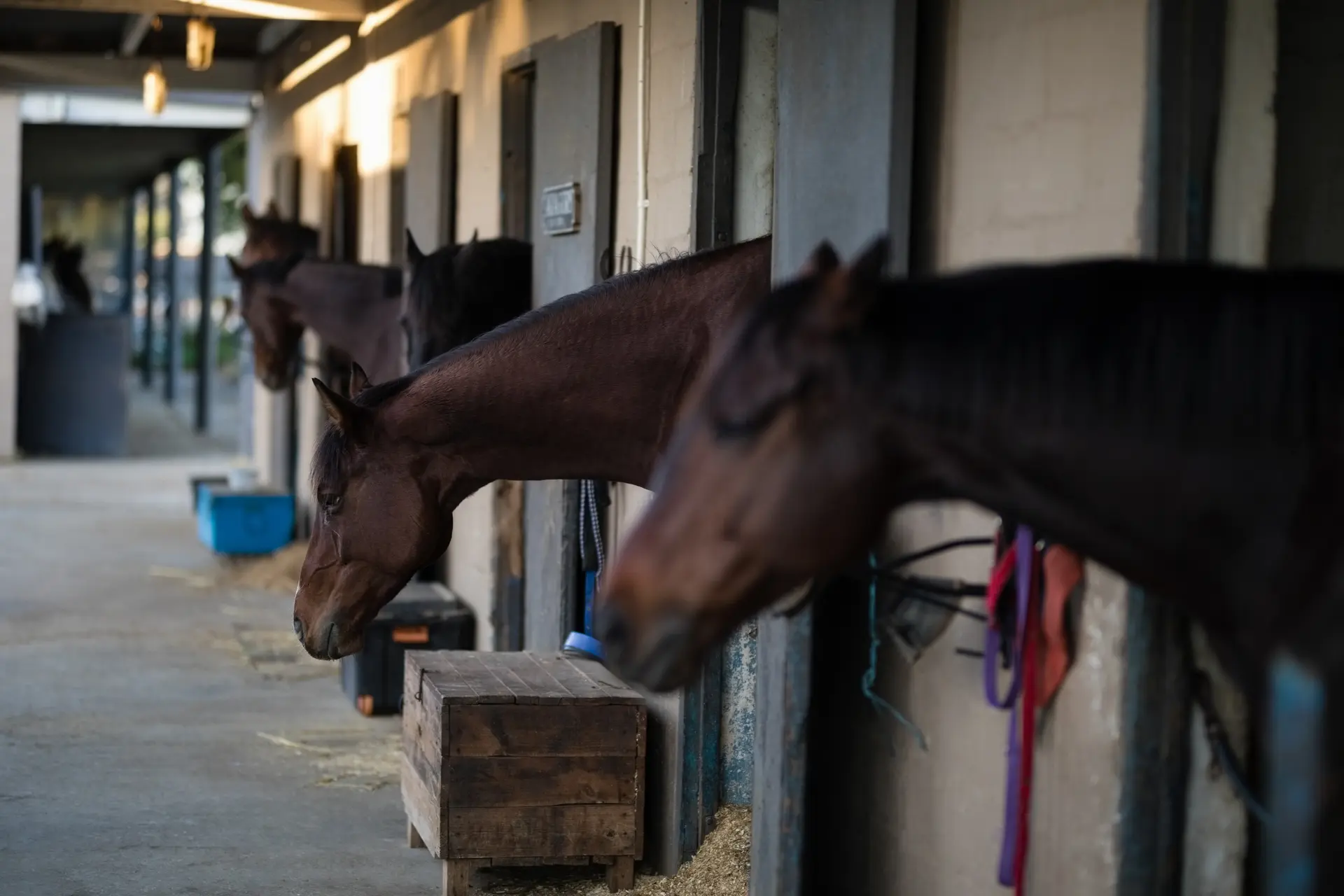
Simple Ways to Improve Ventilation in Horse Barns
For yard managers, horse owners and professionals, there are practical, cost-effective steps you can take to improve stable ventilation:
1. Maximise natural ventilation
Design features such as ridge vents, eaves gaps, stable windows (ideally one at the rear rather than front only) and outward-opening doors contribute to airflow. The BHS emphasises that roof heights should be sufficient to allow air circulation, and windows should avoid plain glass (which can shatter).
2. Control sources of contamination
Hay and bedding are major dust sources. One article noted that feeding from hay nets inside the stall can increase dust exposure three to four times compared with ground feeding (Couëtil, L.L., 2024). Soaking or steaming hay can also greatly reduce airborne dust.
3. Reduce ammonia and moisture build-up
Urine and manure release ammonia; high humidity levels make dust and mould growth worse. Regular mucking-out, good drainage, and ensuring bedding remains dry all matter.
4. Consider mechanical ventilation where needed
If natural ventilation isn’t sufficient (for example, in older buildings, cold-dense climates or fully enclosed barns), mechanical extraction systems can make a real difference. The Swedish study found measurable improvements in air quality and horse airway health after installing such a system (Wålinder, R., Riihimäki, M., Bohlin, S. et al. 2011).
5. Monitor and maintain
Keeping check on air movement (feel if there is a gentle but perceptible flow rather than stagnant air), monitoring condensation, performing regular maintenance (cleaning vents, ensuring fans are working) is vital. Using air quality monitors (for CO₂, humidity, dust) is a bonus for larger yards!
Conclusion: Healthier Horses, Happier Humans
In essence, getting ventilation right in stables is both a responsibility and an investment. If you begin by checking your stable designs through the lens of airflow, dust mitigation and source control, you’re already on the path to better stable air for your horses. With the combination of design, management and (where needed) mechanical support, you’ll give your horses the environment they deserve, and you’ll protect performance, health and welfare in one go.
Reference List
British Horse Society (BHS). (n.d.) Stable Safety. Available at: https://www.bhs.org.uk/horse-care-and-welfare/health-care-management/stable-safety/
Couëtil, L.L. (2024) Poor Air Quality and Lung Damage in Horses. The Horse. Available at: https://thehorse.com/1139360/poor-air-quality-and-lung-damage-in-horses/?lid=57stvz9dtuyb
Skjöldebrand, E., Böhm, M., and Hammarberg, M. (2024) ‘Indoor Climate in Horse Stables during Winter Conditions: Effects of Ventilation and Microclimate on Horse Health’, Agriculture, 12(8), 1287. MDPI. Available at: https://www.mdpi.com/2077-0472/14/8/1287
Wålinder, R., Riihimäki, M., Bohlin, S. et al. Installation of mechanical ventilation in a horse stable: effects on air quality and human and equine airways. Environ Health Prev Med 16, 264–272 (2011). https://doi.org/10.1007/s12199-010-0195-5