For many in the equestrian industry, turnout is treated as a welfare “nice to have” rather than a fundamental need. Yet a growing body of scientific work challenges this view, consistently demonstrating that access to movement, grazing, and social interaction is essential to horses’ mental and physical health.
This review synthesises key studies on turnout duration, turnout type, behavioural welfare, physiological stress, and injury risk to clarify what current evidence suggests about how much turnout horses truly require.
The horse’s behavioural needs
Modern equine management often restricts the three behaviours horses perform most in natural environments: foraging, moving, and interacting socially. Broad welfare reviews (e.g., Krueger et al., 2021; Minero et al., 2009) emphasise that these behaviours are not optional, but are intrinsic biological needs.
Horses evolved to walk many kilometres daily while grazing in social groups. When these needs are not met, behaviour, health, and welfare deteriorate in predictable ways, ranging from frustration and irritability to gastrointestinal issues and stereotypies.
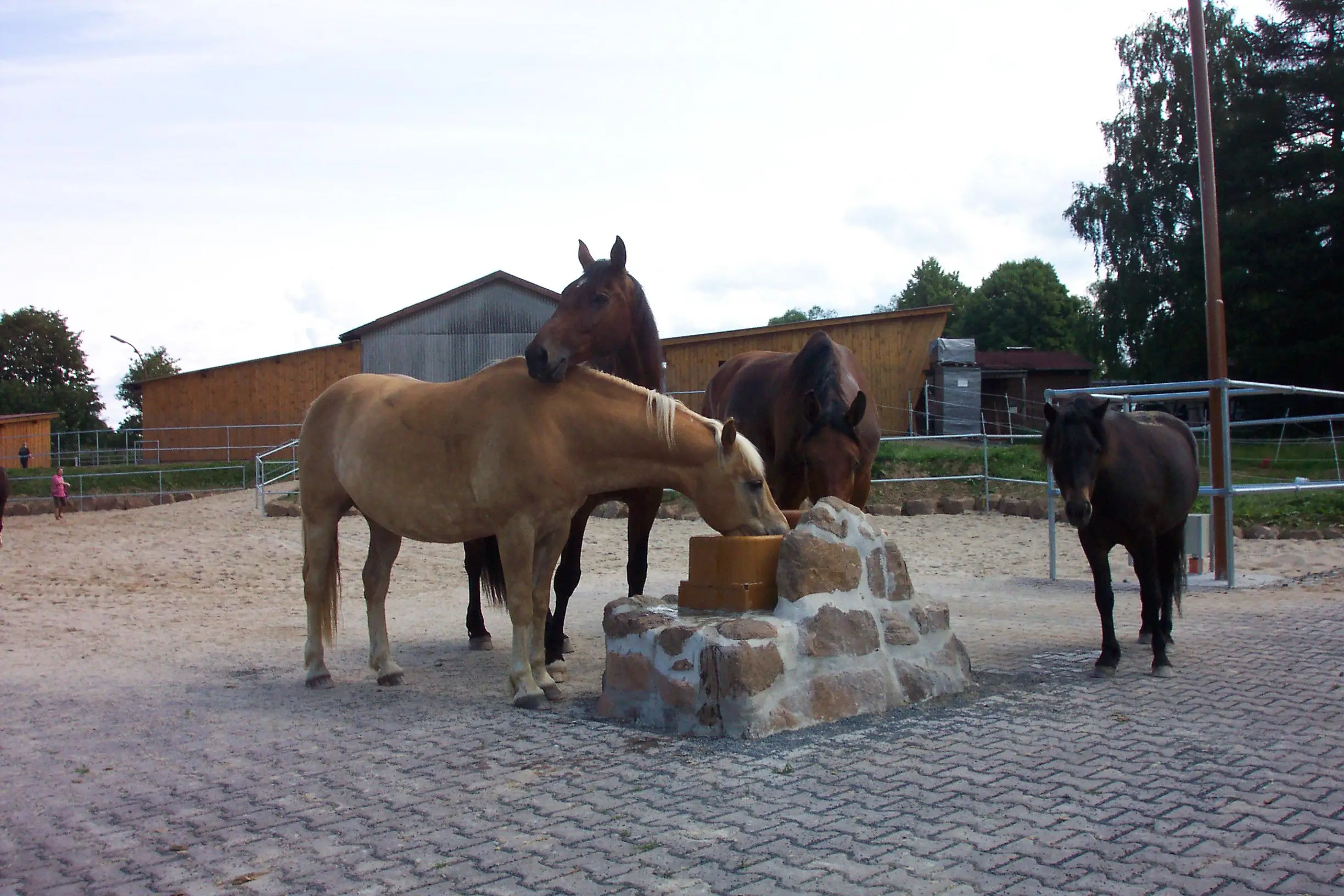
Turnout responds to all three needs simultaneously. It allows for spontaneous movement, ad-lib grazing behaviour (even on sparse grass), and visual or physical contact with others. Consequently, studies consistently report improved behavioural expressions and reduced signs of chronic stress when horses have regular, meaningful turnout opportunities.
How much turnout? Evidence from duration-focused studies
Research that directly manipulates turnout duration is surprisingly rare, but the existing work offers consistent trends. Chaya et al.’s (2006) behavioural comparison of horses receiving very limited turnout versus those with substantially more access found strikingly different activity patterns and indicators of frustration.
Horses deprived of adequate turnout tended to display heightened activity or “rebound” behaviours when finally released; an expected response when animals are prevented from performing a natural behaviour for long periods.
Lesimple (2020) reported similar implications in performance horses, showing that daily free movement is associated with more positive behavioural indicators, whereas interrupting turnout routines leads to measurable deterioration in welfare scores.
While “minimum required hours” cannot yet be determined scientifically, the pattern is consistent. More regular turnout produces healthier behavioural profiles, and abrupt reductions in turnout have negative effects.
Group turnout and the value of social environments
Turnout quality matters as much as quantity. Studies exploring group pasture turnout (e.g., Kettunen, 2024) note marked improvements in calm social behaviour, locomotion, and overall time budgets that more closely resemble those of free-ranging horses.
Group turnout allows horses to meet their social needs, something individual stabling or isolated paddocks cannot replicate.
Recent welfare frameworks (e.g., Phelipon et al., 2024) also underline that social restrictions are a major welfare risk. They argue that basic welfare for horses relies not only on space and movement but on the ability to interact meaningfully with others. This strengthens the case that turnout should, as far as feasible, involve social contact.
Turnout, stress physiology, and behavioural stability
A number of experimental studies have examined physiological and behavioural changes when horses move between stabled and turnout conditions. Werhahn et al. (2011; 2012) found that giving stabled sport horses structured free-exercise or turnout periods leads to calmer behaviour in the stable and reduced indicators of stress. Similarly, Young (2011) reported that both behavioural observations and cortisol profiles are more stable in systems that incorporate regular movement opportunities.
Taken together, these studies suggest that exercise alone cannot substitute for turnout. Even when stabled horses receive ridden or in-hand exercise, the absence of self-directed movement and environmental choice still contributes to stress-related behaviour.
Turnout consistency and injury risk
Concerns about turnout-induced injuries remain a common reason for limiting turnout time. However, emerging research counters much of this fear. In a recent survey-based study, Mouncey et al. (2024) observed that inconsistency in turnout routines, rather than turnout itself, was associated with increased rates of soft-tissue injuries. Horses whose turnout access varied unpredictably were more likely to experience stress-related behaviours and overexuberance when released, which can elevate injury risk.
This points to an important conclusion. Predictable, routine turnout is safer than occasional or irregular access. Horses that move freely every day maintain steadier musculoskeletal conditioning, reducing the likelihood of sudden high-intensity bursts of activity that occur when turnout is rare.
Stabling routines, stereotypies, and long-term outcomes
Decades of research have documented the relationship between restricted movement and the development of stereotypies such as weaving and crib-biting (Sarrafchi, 2012). More recent work (e.g., Bradshaw-Wiley et al., 2023) confirms that stabling regimes that heavily restrict movement and social interaction correlate strongly with behavioural indicators of compromised welfare.
Though stereotypies are multifactorial, limited turnout remains one of their most robust environmental predictors. Long-term prevention depends not only on adequate forage and social contact, but also on meeting the horse’s fundamental need for self-directed movement throughout the day.
Overall conclusion: What does the literature tell us?
While the research does not yet provide a universal formula for the “exact number of hours” of turnout horses need, the scientific consensus is clear and consistent
- Daily turnout is significantly better than intermittent turnout.
- Longer durations produce more stable behaviour and lower stress indicators.
- Group or socially enriched turnout offers stronger welfare benefits than isolated turnout.
- Predictable routines reduce injury risk more effectively than restricting turnout.
- Turnout cannot be replaced by ridden exercise or short periods of controlled movement.
In essence, the literature increasingly recognises turnout not as an optional enrichment but as a core welfare requirement.
Reference List
Bradshaw-Wiley, E., et al. (2023) The effect of stabling routines on potential behavioural indicators of welfare, Journal of Equine Science.
Chaya, L., Cowan, E. and McGuire, B. (2006) ‘A note on the relationship between time spent in turnout and behaviour during turnout in horses’, Applied Animal Behaviour Science, 98(1–2), pp. 155–160. doi:10.1016/j.applanim.2005.08.008.
Kettunen, H. (2024) How group turnout in grass pasture affects horse activity and behaviour. Master’s thesis, Swedish University of Agricultural Sciences. Available at: https://stud.epsilon.slu.se/19922/1/kettunen_h_20240424.pdf
Krueger, K., Esch, L., Farmer, K. and Marr, I. (2021) Basic needs in horses? — A literature review, Animals, 11(6), 1798. doi:10.3390/ani11061798. Available at: https://www.mdpi.com/2076-2615/11/6/1798
Lesimple, C., Reverchon-Billot, L., Galloux, P., Stomp, M., Boichot, L., Coste, C., Henry, S. and Hausberger, M. (2020) ‘Free movement: A key for welfare improvement in sport horses?’, Applied Animal Behaviour Science, 225, 104972, doi:10.1016/j.applanim.2020.104972. Available at: https://www.sciencedirect.com/science/article/abs/pii/S0168159120300502
Minero, M., et al. (2009) ‘Welfare issues of horses: An overview and practical recommendations’, Italian Journal of Animal Science, 8(suppl.1), pp. 67–81.
Mouncey, R., et al. (2024) Associations between turnout practices and injury risk, Equine Veterinary Journal. doi:10.1111/evj.14038.
Phelipon, R., et al. (2024) Forage, movement and social interactions in equid welfare, Animals, 14(2). doi: [insert DOI if available]*.
Sarrafchi, A. (2012) Equine stereotypic behaviour as related to horse welfare. Doctoral thesis, Swedish University of Agricultural Sciences. Available via Diva Portal.
Werhahn, H., et al. (2011) ‘Competition horses housed in single stalls I: Effects of free exercise on behaviour’, Applied Animal Behaviour Science, 134(1–2), pp. 101–111. doi:10.1016/j.applanim.2011.07.006.
Werhahn, H., et al. (2012) ‘Competition horses housed in single stalls II: Effects of free exercise on stress’, Journal of Equine Veterinary Science, 32(11), pp. 708–714.
Young, T.J. (2011) Physiological and behavioural measures of stress in horses under differing management regimes. Doctoral thesis, University of Chester.
Driving innovation in horse keeping