
How do horses sleep?
Horses sleep both standing up and lying down. Standing sleep uses a "stay apparatus" that locks their leg joints, letting them doze without falling and this covers most of their rest. But horses also need to lie down for short periods each day to reach REM sleep, which can't happen standing. Most horses need 3–5 hours of total sleep in 24 hours, including roughly 30–60 minutes of REM sleep, usually taken in several short bouts of a few minutes each rather than one long stretch.
When we think of horses sleeping, we might imagine peaceful images of them resting in a stable or field, but the truth is far more subtle and fascinating. For horses, the deepest phase of sleep, REM (Rapid Eye Movement), is both essential and precarious. In this blog, we’ll explore what REM sleep is, how it applies in horses, why it’s vital, and how we as owners and riders can support it.
What Is REM Sleep?
Sleep is not a uniform “off” state: in mammals it encompasses several stages. In humans, for example, we move from light sleep into deeper slow-wave (non-REM) stages and then into REM, during which the brain is highly active, dreams may occur, and muscle tone drops. The REM phase is thought to play key roles in brain recovery, memory consolidation, emotional regulation and physical restoration.
In horses, while research is more limited than in humans, the same broad framework applies: they too experience non-REM and REM sleep, though the patterns differ (Houpt 2023).
How Horses Sleep: The Basics
Horses are polyphasic sleepers, meaning sleep is broken into many short bouts throughout the 24-hour day rather than one long block. According to a review of the general literature, adult horses average only about 3-5 hours of total sleep per day (AAEP 2008).
They often rest or “doze” while standing, thanks to their stay apparatus (that locking mechanism in the legs), but truly deep sleep, and especially REM, requires them to lie down. Perhaps unsurprisingly for a prey animal, they have evolved this pattern of brief, interrupted rest with a high readiness to wake. From the 2008 AAEP review: “Horses are neither diurnal nor nocturnal but have intermittent periods of rest and sleep during the day with most of their sleep happening at night, particularly when confined in a stall” (AAEP 2008).
So while we may imagine horses sleep “at night,” the reality is more: they sleep in short bouts throughout the day and night, but more of the deeper bouts often occur when the horse feels safe and relaxed.
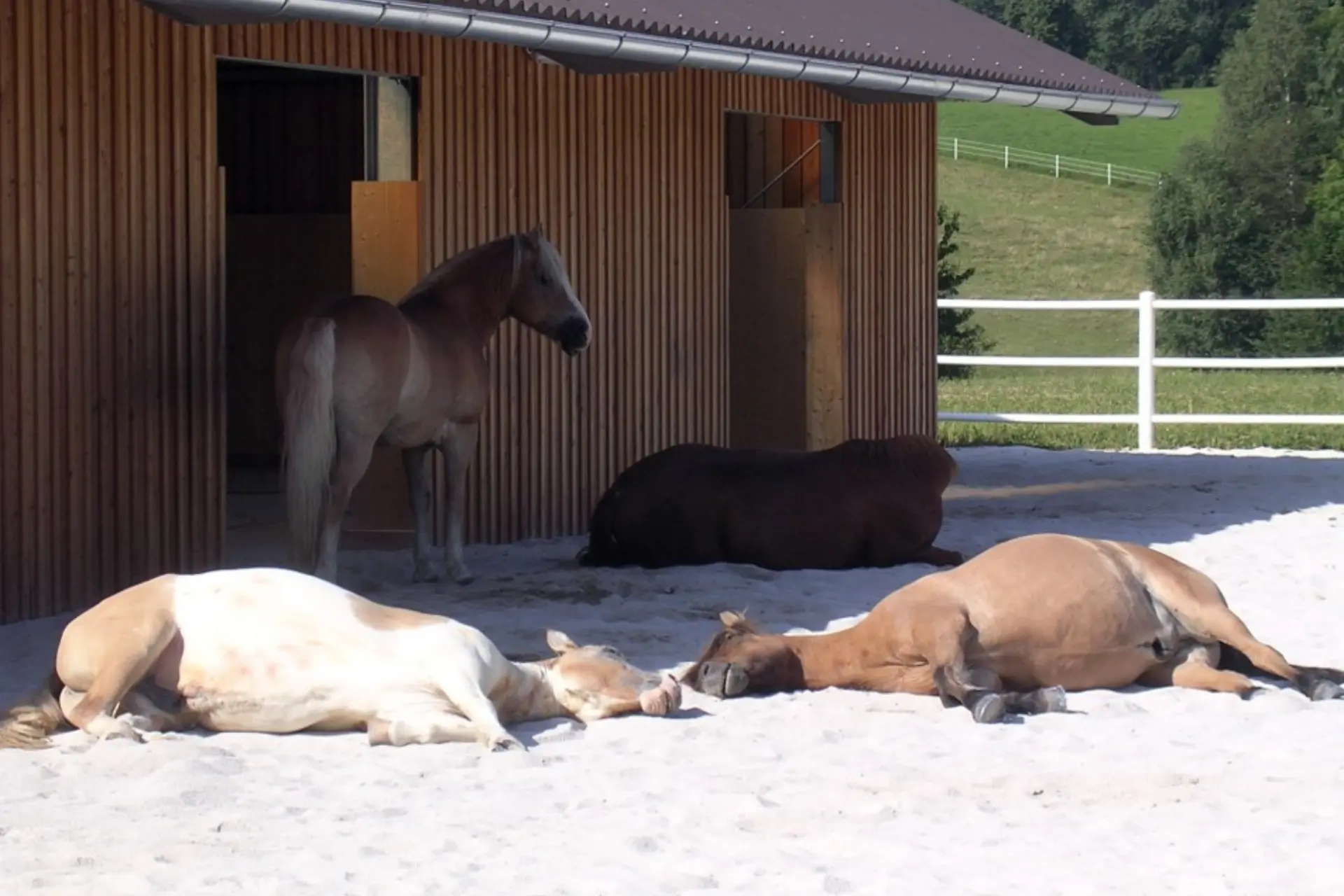
"Horses must lie down for REM sleep"
The Unique Posture Requirement for REM Sleep in Horses
Here’s where things become really interesting. Horses can doze while standing, but they cannot safely enter REM sleep unless they lie down. This is because during REM sleep, there is a marked loss of muscle tone (atonia) in many species, which makes lying down the only safe position for that deep sleep stage.
From the 2008 AAEP review: “… the pressure to enter REM sleep is illustrated dramatically in horses, which are able to stand while in non-REM sleep, but must lie down to safely enter REM sleep. However, when horses are reluctant to lie down, the pressure to enter REM sleep can be so strong that they do so while standing, resulting in a sudden loss of muscle tone and injurious falls” (AAEP 2008).
This underscores that lying down is not just optional; it is physiologically required if a horse is to get REM sleep. It also highlights risks that if a horse is prevented, by pain or environment, from lying down, it may try to slip into REM while still standing.
Why REM Sleep Is Essential for Horses
Despite sleeping far less than humans, horses still depend on REM sleep for several key functions. REM is linked to mental processing, emotional stability, and neurological recovery.
A 2022 welfare-focused review highlights that both sleep quality and quantity are major indicators of equine wellbeing (Lesimple, Bender & Fureix 2022). The AAEP also notes that chronic sleep loss “may seriously impair a horse’s physical activity and quality of life” (AAEP 2008).
Studies on lying and recumbency behaviour further show that horses with more opportunity to lie down (especially in comfortable, socially stable environments) display healthier sleep patterns and improved welfare (Helmerich, Lesimple & Fureix 2025).
How Much REM Sleep Does a Horse Need?
Because horses sleep in short, scattered bouts, the exact amount of REM sleep they achieve can vary greatly between individuals and environments. The 2008 AAEP review notes that adult horses typically achieve only around three to five hours of total sleep per day (AAEP 2008). Within that modest total, only a fraction occurs as REM sleep.
More recent analyses, such as the 2022 review on equine sleep, estimate that REM makes up roughly 17.5% of a horse’s total sleep time, equating to around forty minutes on average (Lesimple, Bender & Fureix 2022). Interestingly, this proportion is quite similar to the human average of about 17%, even though humans sleep far longer overall.
Newer research continues to refine these figures; for instance, Helmerich et al. (2025) observed that horses lying in open spaces with social companions spent more time recumbent, which naturally increased their opportunity for REM sleep. These findings highlight that while horses may not need long periods of continuous sleep, they do require the right conditions to access this crucial stage.
What Prevents Horses From Getting REM Sleep?
A variety of factors can interfere with a horse’s ability or willingness to lie down, and therefore with its ability to enter REM sleep. Pain is one of the most common barriers.
Conditions such as arthritis or gastric discomfort can make the act of lowering the body to the ground and rising again uncomfortable enough that the horse avoids lying down altogether.
Management factors can also play a role. Inadequate bedding, slippery flooring, cramped stalls or turnout areas with hard or uneven ground may deter recumbency.
Social dynamics within a herd are another important influence; a horse that feels insecure, threatened or isolated may remain on its feet to stay alert, even when exhausted.
Importantly, many owners may assume that a horse standing quietly and dozing is “sleeping well,” but standing rest alone cannot provide REM sleep. Without the chance to lie down, a horse may go days or even weeks without achieving this critical phase (Houpt 2023; AAEP 2008).
Recognising REM Sleep Deprivation in Horses
Sleep deprivation in horses often presents in subtle ways before progressing to more dramatic signs. One of the most recognisable indicators is sudden collapse or buckling at the knees. When a horse has been unable or unwilling to lie down, the pressure to enter REM sleep builds to the point where the horse abruptly drops into REM while still standing. Since REM is accompanied by a loss of muscle tone, the horse’s legs can give way beneath it.
The 2008 AAEP review describes this phenomenon clearly, noting how such collapses may result in injuries or abrasions on the fetlocks or knees (AAEP 2008). Behavioural changes can also signal inadequate REM sleep. Horses may appear irritable, unfocused, unusually spooky or resistant to training. They may show reduced stamina or struggle to learn new tasks. In some cases, owners notice that the horse simply never seems to lie down, even when observed over extended periods.
Recent studies, including Helmerich et al. (2025), have highlighted that changes in lying behaviour (shorter bouts, reduced duration or complete absence of recumbency) can reflect issues in the horse’s environment, social situation or health. These behavioural clues often appear long before collapse occurs, making early observation invaluable.
Supporting Healthy Sleep in Your Horse
Promoting healthy sleep in horses begins with making recumbency both possible and appealing. A comfortable, dry and generously bedded resting area encourages horses to lie down, while turnout environments with good footing and adequate space further support natural resting behaviour. Horses that feel secure in their surroundings, especially those with compatible social companions, tend to rest more deeply and more frequently.
Addressing pain is equally important. Regular veterinary care, physiotherapy, appropriate saddle fit and hoof management all play vital roles in ensuring the horse is physically comfortable enough to lie down. Routine and predictability can also influence sleep; horses often rest more soundly when their environment is calm during the night and when human activity is minimal.
Finally, monitoring is invaluable. Some owners rely on direct observation, while others use technology such as wearable sensors or cameras to track lying behaviour. Helmerich et al. demonstrated the usefulness of accelerometers in identifying how often and how long horses lie down. Understanding these patterns can help owners catch sleep-related problems early and adjust management accordingly.
Final Thoughts
Horses may sleep far less than humans, but the sleep they do get, particularly the portions spent in REM, is critically important. A horse’s ability to lie down, and to feel safe doing so, is central to its neurological, physical and emotional health.
Understanding sleep as a component of welfare allows us to refine our management practices and notice problems sooner. In many ways, good sleep is an invisible foundation for good performance, good behaviour and good health.
Reference List
American Association of Equine Practitioners (AAEP). Sleep and Sleep Disorders in Horses. Proceedings of the 54th AAEP Annual Convention, San Diego, California, 2008. Available at: https://www.ivis.org/library/aaep/aaep-annual-convention-san-diego-2008/sleep-and-sleep-disorders-horses
Helmerich, I., Lesimple, C. & Fureix, C. ‘Horses' Lying Behaviour in Different Housing Conditions: Recumbency and Sleep in a Social Context’, Applied Animal Behaviour Science, vol. 273, 2025, 106096. Available at: https://pubmed.ncbi.nlm.nih.gov/38163442/
Houpt, K.A. ‘Sleep in Horses: A Review’, Journal of Equine Veterinary Science, vol. 121, 2023, 104169. Available at: https://pubmed.ncbi.nlm.nih.gov/36061116/
Lesimple, C., Bender, S. & Fureix, C. Sleep and Activity in Horses: Implications for Welfare and Management. Frontiers in Veterinary Science, vol. 9, 2022, 916737. Available at: https://pure.aber.ac.uk/ws/portalfiles/portal/52397935/fvets-09-916737.pdf
Kentucky Equine Research (KER). ‘Achy Joints and Sleep Deprivation in Horses’. KER Equinews, 2018. Available at: https://ker.com/equinews/achy-joints-and-sleep-deprivation-in-horses/

Housing designed for your horse
We specialise in horse housing systems designed with horses first.
Facility Design