
Constructing a horse arena is a significant investment that can improve year-round riding, enhance horse welfare, and increase the value and functionality of an equestrian property. However, the long-term performance of an arena is determined long before the surface is installed. Careful planning, correct ground preparation, effective drainage, and quality construction are all essential to creating an arena that performs consistently and reliably for years to come.
Whilst the finished riding surface often receives the most attention, it is the engineered foundation beneath it that ultimately determines how well an arena drains, how consistently it rides, and how much maintenance it will require over its lifetime (Performance Footing).
Understanding each stage of the construction process allows arena owners to make informed decisions, helping to avoid costly mistakes and ensuring the finished arena meets both current and future demands.
Step 1: Defining Your Requirements
Before any excavation begins, it is important to establish the arena’s intended purpose. This includes a range of factors such as; riding discipline, expected footfall, existing infrastructure, and how the space will operate on a day-to-day basis. A private schooling arena may have very different design requirements from a commercial competition venue or professional training facility. Similarly, an arena designed for dressage horses will have different design requirements from one intended for western disciplines.
Key considerations include:
Primary discipline
Expected frequency of use
Expected number of horses using the arena
Indoor or outdoor construction
Standard arena dimensions (such as 20m x 40m or 20m x 60m)
Available space and site restrictions
Local ground conditions and natural drainage
Budget for construction and ongoing maintenance
These decisions influence everything from surface selection to drainage design and overall construction costs. Planning for future expansion or increased usage at this stage can also prevent expensive alterations later.
Step 2: Choosing the Right Location
Selecting an appropriate site is one of the most important decisions during the planning process. Even the highest-quality construction materials cannot compensate for poor site selection.
Ideally, the chosen location should:
Have naturally free-draining ground
Be relatively level to minimise earthworks
Provide good access for construction machinery and future maintenance equipment
Allow adequate space for drainage systems and vehicle access
Avoid areas prone to flooding or excessive groundwater
The surrounding landscape should also be considered carefully. Water naturally flows downhill, meaning neighbouring fields, banks or hardstanding areas may direct additional water towards the arena if suitable drainage measures are not incorporated during construction.
Step 3: Planning Permission and Site Surveys
Depending on the location and intended use of the arena, planning permission may be required. Local authority requirements can vary, particularly where lighting, access roads, commercial use or changes to land use are proposed.
Before construction begins, many contractors recommend undertaking site investigations to assess:
Soil composition
Groundwater conditions
Existing drainage
Ground stability
Topography
These surveys help determine the most appropriate construction method while reducing the likelihood of drainage or settlement problems developing in the future.
Step 4: Groundworks and Excavation
Groundworks form the foundation of every successful arena build. Once the site has been marked out, topsoil is removed before the formation level is established.
Depending on the terrain, this may involve; cut-and-fill earthworks, laser levelling, soil stabilisation, and formation of retaining banks where required.
The aim is to create a stable, accurately level platform capable of supporting the drainage system and subsequent construction layers. Poor preparation at this stage can result in uneven settlement, inconsistent footing and ongoing maintenance challenges.
Step 5: Installing Effective Drainage
Drainage is widely regarded as the most critical element of arena construction. Without effective water management, even the highest quality riding surfaces can quickly become inconsistent, waterlogged or unstable.
Most professionally constructed arenas include:
Perforated drainage pipes
Stone-filled drainage trenches
Geotextile membranes
Carefully designed surface gradients
Suitable outfalls or soakaways
Together, these components allow water to move efficiently through the arena profile while preventing contamination of the drainage stone by surrounding soils.
Poor drainage often leads to standing water, surface movement and accelerated wear, all of which increase maintenance requirements and reduce riding quality. When combined with a well-designed drainage system, effective irrigation helps create a more controlled arena environment, allowing excess water to be managed during wet conditions, and supporting optimal moisture levels during periods of dry weather.
ArenaMate® AquaUnder is an underground irrigation system designed to distribute water from beneath the riding surface, helping to maintain more consistent moisture levels throughout the footing profile. By delivering water through a concealed subsurface system, the AquaUnder can support more even moisture distribution, reduce dust and help maintain the stability and cushioning of the riding surface.
Step 6: Building the Arena Base
Once drainage has been installed, construction of the sub-base begins. This engineered layer distributes weight evenly while providing a stable platform for the riding surface.
A typical arena build includes:
Compacted subgrade
Free-draining aggregate or stone layer
Geotextile separation membrane
Surface layer suitable for the chosen riding discipline
Each layer performs a specific function, and precision during installation is essential to ensure the arena remains stable under repeated loading from horses and maintenance equipment.
Step 7: Selecting the Riding Surface
The riding surface has the greatest influence on how the arena feels underfoot during use, and significantly contributes to horse welfare, performance and injury-prevention.
Modern equestrian surfaces commonly include:
Silica sand
Sand and fibre blends
Wax-coated surfaces
Sand and rubber mixtures
Surface selection should reflect the intended discipline, local climate and maintenance capability. Regardless of material, consistency is essential. Uneven or poorly maintained footing can alter hoof-surface interaction, increase fatigue and contribute to unnecessary musculoskeletal strain. Research has demonstrated that surface characteristics directly influence horses’ loading patterns, making surface selection an important welfare consideration (Witte et al., 2006).
Step 8: Installing Fencing and Finishing Features
Once the riding surface has been installed, the final stage of construction focuses on the surrounding infrastructure and finishing features that support the arena's functionality and long-term use.
Common finishing elements include:
Arena fencing
Kickboards
Access gates
Mirrors
Lighting
Irrigation systems
These elements can make a significant difference to the functionality, safety and long-term usability of an arena. For a complete, one-stop solution, Jelka and ArenaMate® offer a range of high-quality products specifically designed for equestrian environments, including arena kickboards, arena mirrors and advanced irrigation solutions. Providing arena owners with a convenient way to source purpose-built products, helping to create a more practical and professionally designed riding environment from the outset.
Step 9: Ongoing Arena Maintenance
Construction is only the beginning of an arena's lifecycle. Regular maintenance is essential to preserve surface quality, protect the underlying construction and maximise the lifespan of the investment.
Routine maintenance should include:
Regular levelling
Monitoring surface depth
Maintaining drainage systems
Irrigating during dry conditions
Removing debris and organic matter
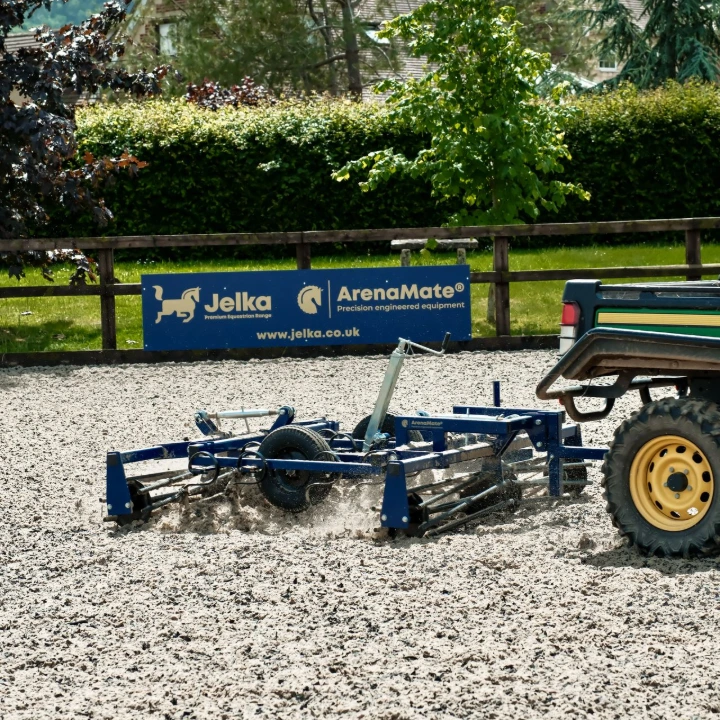
Using a purpose-built arena leveller helps redistribute the riding surface evenly, preventing the development of deep tracks, compacted areas and uneven footing. Regular levelling is an important part of maintaining surface consistency and can help reduce the additional strain placed on horses when working on inconsistent ground.
ArenaMate® Levellers
ArenaMate® ‘s range of fully-customisable arena levellers is designed to support routine maintenance, helping arena owners maintain optimum surface conditions while protecting the integrity of the underlying construction. Likewise, maintaining consistent moisture levels with an irrigation system reduces dust and helps preserve the performance of the surface.
Proactive maintenance not only improves riding consistency but also reduces long-term repair costs by protecting the engineered layers beneath the surface.
Conclusion
A successful riding arena is built from the ground up. While the surface may be the most visible component, it is the planning, drainage, groundworks and engineered base that determine how the arena performs throughout its lifespan.
Investing time in proper site selection, professional construction and quality materials creates an arena capable of delivering reliable performance in all seasons. Combined with regular maintenance using appropriate levelling and irrigation equipment, a well-built arena provides safer, more consistent footing for both horse and rider while protecting the value of the original investment.
Whether you are planning a private schooling arena or a larger commercial facility, working with experienced professionals from the outset can make a significant difference to the long-term success of the project. Through its network of trusted arena construction specialists, ArenaMate® can supply experienced contractors to help guide every stage of the build, from initial planning and groundwork through to the finished riding surface.
Once construction is complete, both ArenaMate® and Jelka offer a range of high-quality arena products designed specifically for equestrian environments, including arena levellers, irrigation systems, arena kickboards and arena mirrors. This provides arena owners with access to trusted construction expertise and purpose-built products to support the arena throughout its entire lifecycle, from initial planning and installation through to ongoing maintenance and use.
Ultimately, constructing an equestrian arena should be viewed as an engineering project rather than simply installing a riding surface. By understanding each stage of the build process, arena owners can make informed decisions that support long-term durability, performance and equine welfare.
Reference List
Day Equestrian (n.d.) Riding Arena Construction Guide - Part 3: Installing the Base. Available at: https://dayequestrian.co.uk/arena-building-guide-part-three/
Drainfast Ltd. (2023) Horse Arena Construction & Drainage: Getting It Right. Available at: https://www.drainfast.co.uk/blog/horse-arena-construction-drainage
Performance Footing (n.d.) Horse Arena Construction Guide. Available at: https://www.performancefooting.com/arena-construction-guide
CDS Arenas (n.d.) Drainage Solutions. Available at: https://cdsarenasandgroundworks.co.uk/drainage-solutions/
CDS Arenas (n.d.) Riding Arena Construction Guide. Available at: https://cdsarenasandgroundworks.co.uk/arena-construction-guide
Witte, T.H., Knill, K., Wilson, A.M. and Townsend, H.G.G. (2006) 'Determination of peak vertical ground reaction force from duty factor in the horse', Equine Veterinary Journal, 36(S36), pp. 597–601. Available at: https://pubmed.ncbi.nlm.nih.gov/15371472/