
Your horse's movement is only ever as good as the surface it works on. A well-maintained arena with consistent moisture and even depth supports the horse through every phase of its stride - absorbing impact at landing, providing resistance during loading, and returning energy at push-off. A poorly maintained one does the opposite, and the consequences show up gradually: a horse that feels uneven behind, a recurring soft tissue problem that won't resolve, a training session where nothing quite clicks despite the horse seeming sound.
Most riders know their surface matters. Fewer understand exactly what is happening beneath the hoof at each phase of the stride, and how specific surface failures map to specific problems. That is what this post covers.
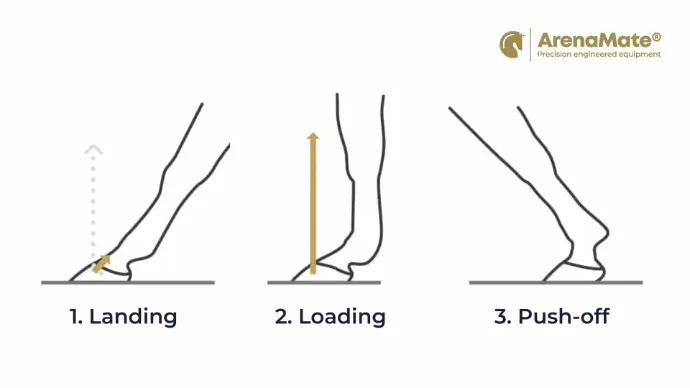
The Three Phases of Footfall
Phase 1: Landing
The moment the hoof makes contact with the ground, the limb is doing something remarkable. It decelerates the horse's entire bodyweight - up to 2.5 times it in some gaits - absorbing that force through the joints, tendons and soft tissue in a fraction of a second (Chateau et al., 2010). The surface plays a direct role in how much of that force the limb has to handle alone.
A correctly maintained surface compresses slightly on contact, taking some of the shock before it travels up the leg. A hard, compacted surface - one that has dried out, lost its fibre content, or not been levelled regularly - does not compress. The full force of landing transfers straight into the hoof and up the limb. Individually each stride still feels normal. Cumulatively, over weeks of daily work, it is the kind of loading that causes microtrauma to joints and contributes to degenerative change over time (Setterbo et al., 2009).
The rider rarely feels this directly. What they notice instead is a horse that starts to feel wooden in front, or that is reluctant to work on a harder rein, or that a vet eventually describes as having chronic low-grade joint inflammation with no single obvious cause.
Phase 2: Loading
Once the hoof is on the ground, the full weight of horse and rider transfers onto that limb. The fetlock drops, the flexor tendons and suspensory ligament engage to stabilise the leg, and the frog makes contact with the surface, stimulating blood circulation through the hoof. Everything in this phase depends on the surface being consistent and at the right depth.
Too hard and the surface cannot cushion the load - force returns through the limb rather than being absorbed. Too loose or uneven and the leg has to work to stabilise itself rather than simply support the weight, which means the soft tissues are doing corrective work on top of their normal load. Studies have shown that inconsistent footing alters stride mechanics during loading in ways that lead to muscle fatigue and overcompensation injuries over time (Hobbs et al., 2014).
The practical version of this is a horse that trips or stumbles more than expected, or that develops asymmetric muscle development on one side - a sign the limbs are loading differently because the surface is giving them different information underfoot.
Phase 3: Push off
The final phase is where the hoof rotates forward over the toe and drives into the next stride. A good surface stores a small amount of energy during loading and returns it here - a quality sometimes described as surface responsiveness or energy return. It is what makes a well-maintained arena feel different to ride on compared to one that has gone dead: the horse moves more freely, covers the ground more efficiently, and tires more slowly.
When the surface is too dry and compacted, it has lost the elasticity to return energy. The horse has to generate more muscular effort per stride to achieve the same forward movement. When the surface is uneven - deep in some areas and firm in others - the push-off varies from stride to stride, which is particularly problematic in collection work where the horse is already asking its hindquarters to carry more weight. An inconsistently responsive surface makes collection feel harder to the horse than it should, and riders often mistake this for a training or strength issue when the surface is the actual variable.
The superficial digital flexor tendon is particularly vulnerable during push-off on a surface that does not return energy consistently. It is not coincidental that this is one of the most common sites of injury in competition horses working on poorly maintained arenas.
What Poor Surface Management Costs Your Horse Over Time
The three phases above describe what happens in a single stride. The problem with a poorly maintained surface is not any one stride - it is what happens when every stride for months or years is slightly wrong.
A dry, compacted surface that has not been levelled regularly increases peak impact forces at landing on every step. A surface with inconsistent depth creates uneven loading from one stride to the next. A surface that has lost its moisture and fibre content stops returning energy at push-off. None of these feel dramatic in isolation. Together, over a season of regular work, they create the conditions for the injuries that end competition careers and frustrate leisure riders in equal measure - tendon damage, joint degeneration, asymmetric muscle development, and chronic low-grade lameness that is difficult to pin to a single cause.
Research from Murray et al. (2010) identified a significant correlation between inconsistent and poorly maintained footing and increased soft tissue injuries, particularly in show jumping and eventing disciplines where landing forces and push-off demands are highest.
The other consequence is subtler but equally important: a horse that is working on a surface that does not support it correctly will compensate. It will adjust its movement, shift load between limbs, shorten its stride, or avoid certain movements. Riders interpret this as training problems, resistance, or loss of form. In many cases the surface is the variable - not the horse.
Infographic showing the 3 stages of footfall in horses
How Maintenance and Irrigation Protect Each Phase of the Stride
Everything covered above - the shock absorption at landing, the consistent resistance during loading, the energy return at push-off - depends on two things being right: the surface being level and evenly mixed, and the moisture content sitting within the optimal range for your surface type.
Levelling
Regular levelling with the right equipment keeps the surface material evenly distributed and prevents the compaction that reduces shock absorption at landing. A surface that has not been levelled correctly develops hard patches, deep areas and inconsistent depth - exactly the conditions that create uneven loading and alter stride mechanics over time. Tines mix and redistribute the surface material, while rollers consolidate it back to a consistent depth. Together they restore the evenness the horse needs to move through all three phases correctly. ArenaMate levellers are designed specifically for this - available in configurations to suit all surface types and towing vehicles.
Moisture
Moisture determines how the surface behaves at every phase. Too dry and the surface hardens, losing its ability to compress at landing and return energy at push-off. Inconsistent moisture across the arena means the horse encounters different footing from stride to stride, which is where compensatory movement patterns begin. Consistent moisture at depth - not just at the surface after a spray - is what actually protects the horse.
Manual watering struggles to achieve this consistently across a full arena. HIT Active-Aqua delivers water directly to the sub-base via patented dripline technology, maintaining consistent moisture at depth across the entire surface without interrupting riding sessions. For a full comparison of ArenaMate irrigation options, see our Arena Irrigation Systems guide.
Getting Your Surface Right
The three phases of footfall happen thousands of times in a single schooling session. Whether your horse is in light hacking work or full competition training, the surface is either supporting that movement or quietly working against it - and the difference shows up slowly enough that it is easy to attribute to other causes.
The two variables within your control are consistency of depth through regular levelling and consistency of moisture through the right irrigation system. Both are maintenance decisions, not one-off investments, and both have a direct line to the soundness and performance of every horse that works on the surface.
For more on how moisture affects your surface at a material level, read Why Arena Surface Moisture Matters. For irrigation system options from ArenaMate, see our Arena Irrigation Systems guide.
If you have a question about your arena surface or want advice on levelling or irrigation equipment, get in touch with the ArenaMate® team.
Got a question about arena maintenance?
Reference List
Chateau, H., Degueurce, C., Denoix, J. M. (2010). "Three-dimensional kinematics of the equine distal forelimb: Effects of ground surface." Veterinary Journal.
Setterbo, J. J., et al. (2009). "Surface effects on racehorse injury and performance: A biomechanical perspective." Equine Veterinary Journal.
Hobbs S.J., Northrop A.J., Mahaffey C., Martin J.H., Murray R., Roepstorff L., Peterson M. (2014). Equine Surfaces White Paper. Federation Equestre Internationale, Lausanne, Switzerland.
Murray, R. C., Walters, J. M., et al. (2010). "Surface properties, limb kinematics and tendon strain in horses during jumping: Risk factors for injury?" Equine Veterinary Journal.