
What is horse herd hierarchy?
Horse herd hierarchy is the social ranking system that naturally emerges in any group of horses. Every herd develops a structure with dominant horses at the top - typically an alpha who leads decisions around movement, food and safety - and more submissive horses below. This hierarchy is not fixed and can shift when horses are added, removed or when resources change. Understanding where each horse sits in the group helps owners match turnout companions more effectively, spot signs of bullying or stress early, and create environments where every horse can feed, drink and rest without conflict.
Why Understanding Herd Hierarchy Matters
In recent years, there has been an encouraging shift away from isolated stabling towards practices that honour the horse’s innate need for companionship and freedom. However, simply turning horses out together does not guarantee a stable social environment. Without an understanding of how herd dynamics function, we risk inadvertently placing horses in distressing or even dangerous situations.
By observing how horses communicate and respond to others in their group, we can decipher emotional cues, spot signs of bullying or social isolation, and create better-matched herds. This insight also strengthens the human-horse bond, as we begin to interpret behaviour that might otherwise be misread as disobedience or naughtiness.
Key Roles Within the Herd: Alpha, Omega, and Pair Bonds
Alpha
In any group of horses, a social hierarchy will naturally emerge. At the top of this structure is typically the alpha, often a dominant mare in wild herds, though in domesticated settings, this role can be filled by either gender. The alpha is not necessarily the most aggressive horse but rather the one others defer to for decisions regarding movement and perceived safety. They often lead the group to food, water, and shelter, and their calm confidence helps anchor the rest of the herd.
Omega
At the other end of the spectrum is the omega, who holds the lowest social rank. These horses are often submissive, avoiding conflict and sometimes bearing the brunt of displaced aggression from others. Understanding who the omega is within a group is crucial, as they may be more susceptible to stress or injury if improperly managed.
This is also why the placement and number of water and feeding points matters - a subordinate horse blocked from a single shared trough by a dominant herd member may go without drinking for hours at a time. Multiple auto drinkers positioned away from each other remove this pressure point entirely.
Finding bonds between horses
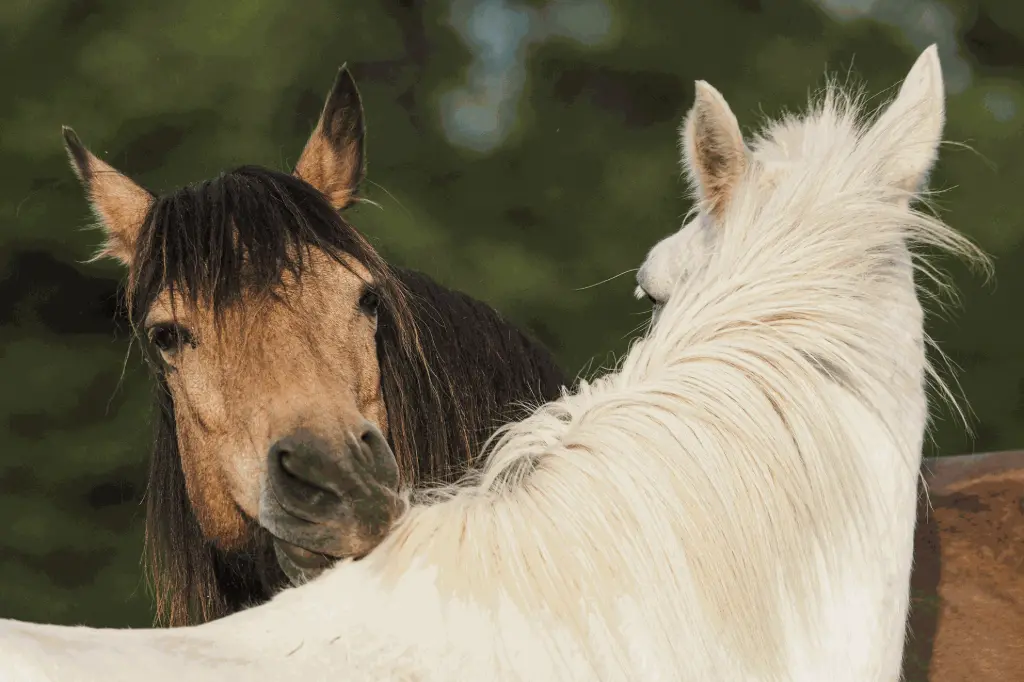
Between these poles, most horses find their place based on temperament, history, and experience. In many herds, pair bonds also develop, deep friendships that can be as important to horses as familial ties. These bonds are often marked by mutual grooming, close proximity, and mirrored behaviour. Horses with strong pair bonds may become stressed if separated, and recognising these relationships is essential for both turnout and training scenarios.
The Three C’s of a Stable Herd: Communication, Coordination, and Cohesion
A harmonious herd, whether wild or domestic, relies on three key principles: communication, coordination, and cohesion.
Communication
Horses are masters of non-verbal communication. Through subtle changes in body language (ears, tail, posture, and facial tension) they express mood, intent, and hierarchy. A slight pinning of the ears or a swish of the tail can signal irritation, while soft eyes and mutual grooming reflect trust and companionship. Observing these cues allows owners to identify friction or anxiety within the group.
Coordination
This refers to the herd’s ability to move together as a unit, whether fleeing a perceived threat or simply changing grazing areas. In wild herds, this is often led by the alpha, and in domestic herds, we can see similar patterns emerge. Horses will fall into roles, some lead, some follow, and these roles are critical when pairing horses for turnout. Disruption in coordination (e.g., one horse always being left behind) can signal deeper social issues.
Cohesion
Cohesion is the emotional glue that binds a herd. It allows for mutual grooming, resting in close proximity, and shared vigilance. A cohesive group looks at ease, no constant posturing or bullying, and each member feels secure in their place. This is the ideal we aim for in domesticated groups, but achieving it requires careful observation and management.
Wild Herds vs. Domestic Groups: Nature vs. Nurture
In the wild, horse herds typically consist of a dominant stallion, several mares, and their offspring. The group is largely matriarchal in its daily function, with older mares leading travel and grazing decisions, while the stallion protects the group from external threats. This natural arrangement allows horses to build long-term social knowledge and pass down behavioural norms.
Domesticated horses, however, rarely enjoy the luxury of choosing their herdmates. Instead, humans construct groups based on convenience, availability, or superficial compatibility. This makes it all the more vital to assess how horses interact within these artificial herds. According to a 2023 study in Animals (MDPI, 2023), improperly matched herds can result in chronic stress, inhibited feeding behaviour, and increased injury risk.
This is one of the reasons group housing systems like HIT Active Stable are designed around managed resource access - individual horses are identified by transponder, feeding is automated and allocated per horse, and the layout separates water, forage and rest areas to reduce the competition that hierarchy naturally creates.
When introducing new horses, owners should monitor not only for overt aggression but also for more subtle signs of stress: refusal to eat, constant vigilance, or being kept away from shared resources. Equally, some horses may thrive better in small, consistent pairings than in larger, more complex groupings.
Where Does Your Horse Sit in the Hierarchy?
Deciphering your horse’s position in a herd involves close, consistent observation. Does your horse initiate movement or follow others? Do they gain access to resources without conflict, or do they linger until others are finished? Are they sought out for mutual grooming, or largely left alone?
Emotional responses are equally telling. A horse at ease in their social role will display relaxed body language, interact willingly, and rest confidently in the presence of others. Conversely, a horse that’s constantly on edge, frequently driven away, or isolated may be struggling with their social placement.
Understanding these dynamics can help us advocate for our horses more effectively, choosing better turnout companions, intervening in cases of bullying, and recognising when a horse needs support in adapting to group life.
Building Better Herds
Managing domesticated horse herds is both an art and a science. While we can never fully replicate the fluid intelligence of a wild herd, we can learn from its principles. Prioritising communication, coordination and cohesion within our groups creates safer, happier environments for our horses. By observing and respecting the social dynamics at play, we make better decisions about who horses live with, how resources are laid out, and what kind of environment genuinely supports their social needs.
For yards looking to put these principles into practice at a structural level, HIT Active Stable is a group housing system built around exactly this - horses live together as a herd, move freely between feeding, water and rest areas, and feeding is automated and individualised so every horse gets their allocation regardless of their position in the hierarchy. It removes the resource competition that causes the most stress in domesticated groups, without removing the social interaction that horses need.
If you are considering how your yard could better support your horses' social needs, speak to the Jelka team or read our practical guide to creating an Active Stable on a budget.
Reference List
Bradshaw, R. (n.d.). Social Structure of the Horse. Association of Pet Behaviour Counsellors (APBC). Available at: https://www.apbc.org.uk/wp-content/uploads/APBC-Article-Social-Structure-of-the-Horse.pdf
Brown, C. (2023). Understanding Herd Dynamics. The Horse. Available at: https://thehorse.com/111721/understanding-herd-dynamics/
Hausberger, M., Gautier, E., Biquand, V., Lunel, C. and Jégo, P. (2017). Could leadership be an alternative to dominance? Primates, 58(2), pp. 205–217. https://doi.org/10.1007/s10329-017-0614-y
Keeling, L.J. and Forkman, B. (2007). The Welfare of Horses. Dordrecht: Springer. Available at: https://books.google.co.uk/books?id=GHKuEeqC4U0C&pg=PA83
Søndergaard, E., Christensen, J.W., Malmkvist, J. and Palme, R. (2023). Social dynamics and effects of regrouping in domestic horses—A review. Animals, 13(9), 1473. https://doi.org/10.3390/ani13091473